The latest annual figures show a jump in FOI requests to government departments.
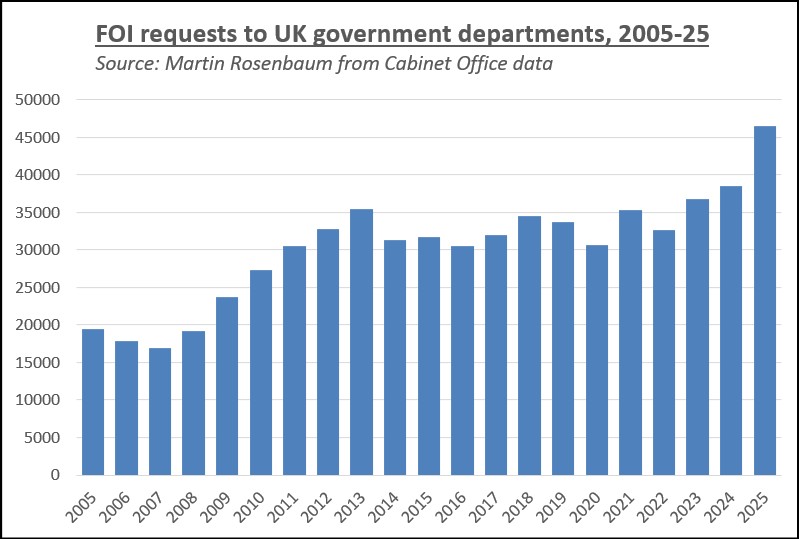
The government’s freedom of information statistics issued today show there was a significant increase last year of 21% in requests to UK central government departments.
The number of FOI applications to departments reached 46,545 in 2025, up from 38,536 in the previous year. This included particularly large increases for the Home Office and the Department of Work and Pensions.
This chart shows the figures for FOI requests received by UK government departments since the law came into force in 2005.
Clearly there are many reasons for why people submit FOI requests, but I belong to the camp who think that one cause of the jump is probably the use of AI. When people seek advice on their problems with parts of the state, chatbots may suggest making FOI applications and indeed offer to draft them to make the process easier.
I’ve previously analysed how numerous national complaints bodies are now receiving a greater quantity of cases.
In this way AI is helping some people to discover their legal rights and also assisting those who are less confident or knowledgeable about how to assert them.
However one problem for FOI officers on the receiving end is that AI-generated requests are often not well targeted or phrased. Although their quality has improved, nevertheless as with much AI writing they tend to be verbose and typically may contain multiple overlapping questions, asking for similar material in slightly different ways.
While it’s possible to write prompts to try to avoid this, the people who would be good at constructing those prompts are probably not the same as those who are only making FOI requests now because AI has shown them how to do so.
(If you’re looking for help on drafting a better FOI request, I would of course suggest that instead of consulting an AI, you would get much more beneficial advice from my book – Freedom of Information: A practical guidebook.)
Note that these statistics only cover UK central government and so these requests only constitute a small proportion of the FOI applications submitted across the public sector.
Ongoing research by Ben Worthy of Birkbeck College, University of London, into local government and FOI is producing findings that are consistent with this notion of some increase in requesting linked to use of AI.
These figures have come out in the wake of reports that the government is currently considering measures to curtail FOI. An article in the Financial Times last month suggested there are discussions about reducing the cost ceiling, so that more requests would be rejected as too expensive.
Another piece described fears within government that FOI is being used by agents of hostile states and China in particular to obtain unclassified details which could be pieced together to reveal more sensitive defence and security information.
In response journalists and campaigners have pointed out that cutting the maximum cost probably won’t save much money, that public bodies could make FOI savings in any case by actually being more open and less obstructive, and that worries about ‘jigsaw’ disclosures are already catered for under existing law. A useful piece by Julia Cushion of mySociety, which runs the whatdotheyknow website, has collated some good articles, including ones by George Greenwood of the Times, Jenna Corderoy of Democracy for Sale, and Claire Miller, as well as Alex Parsons of mySociety.
I’d also draw attention to this insightful piece of analysis by Ben Worthy.
Any attempt by government to restrict FOI will be strongly resisted by the media. Whether or not more does come of this remains to be seen
In my view FOI expenditure should be money well spent, because of the increased transparency and accountability of the public sector, as well as important specific benefits that follow from particular disclosures.
FOI involves some cost to the public sector, but it can also save large sums by deterring wasteful and unnecessary use of resources.
For some public authorities I have dealt with, it is clear to me they could save money by being more efficient and less obstructive.
And in this context there is some other very interesting data in the latest government statistics. The proportion of internal reviews which partly or fully overturn initial withholding of information has risen again and now stands at 28%.
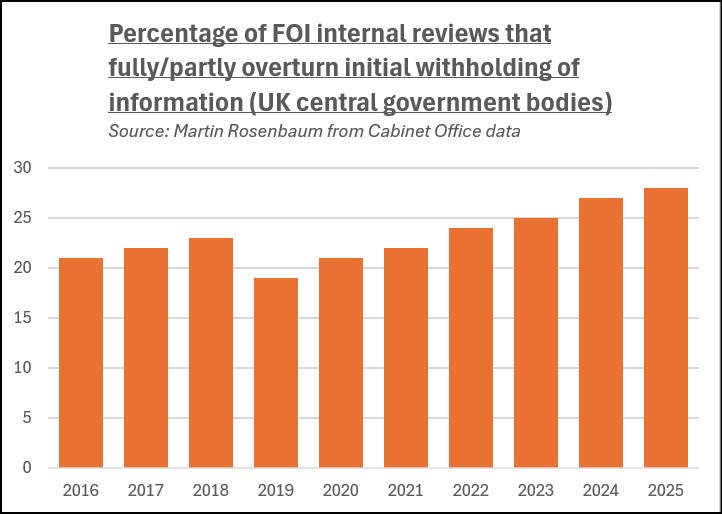
This is why on my FOI training courses I always advise that if you have a decent case then it is worth asking for an internal review.
I believe there’s a problem of incentives. In some public bodies, FOI officers feel they could get in trouble for releasing information, but they don’t get much blame for withholding material in a way that is later overturned. So if in doubt, they withhold. This results in unjustified rejections, many more internal reviews and much more time of senior staff being wasted on carrying them out – and it’s a task which those staff often resent. Authorities that want to be more efficient need to change this pattern of incentives for front-line FOI officers.
Complaints to the ICO and tribunal cases can eat up even more time of senior staff and legal advisors. Authorities which find themselves going through these processes because they have been unhelpful at the first stage may end up wasting a lot of public money that could be better spent elsewhere.
One fairly recent example (as revealed by Jenna Corderoy) is the Cabinet Office spending £15,000 on legal fees in an unsuccessful attempt to stop me discovering reasons Boris Johnson provided to the House of Lords Appointments Commission to justify peerage nominations.
Notes
For comparing trends in numbers of requests over time, I use the figures for government departments, rather than for all the central government bodies whose statistics are collected by the Cabinet Office. That’s because in recent years the figures for the non-departmental bodies have been distorted by a spike of very high volumes of requests to the National Archives for historic service personnel records. Previously these files were held by the Ministry of Defence, who treated applications for them as business-as-usual rather than FOI.
Statistics about FOI requests to other public bodies are not collected centrally in England, Wales and Northern Ireland. Larger authorities with over 100 staff are meant to publish their figures under the Cabinet Office’s code of practice, but many don’t. The Information Commissioner’s Office has recently started cracking down on this, issuing practice recommendations to some authorities, but there’s a long way to go before there is general compliance.