The transcript of a recent podcast interview where I discuss how journalists use FOI, tactics, how the law should be improved, fighting tribunal cases, and some of my favourite stories …
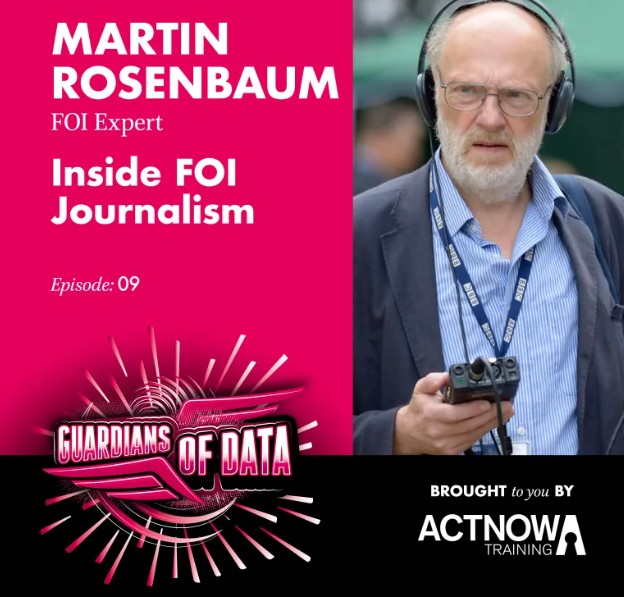
I was interviewed by Ibrahim Hasan of ActNow Training, the information governance legal specialists, for his podcast series Guardians of Data.
This is a lightly edited transcript. (It was automatically generated, so may contain some minor errors). You can listen to the podcast here.
Ibrahim’s interviews with figures from the information rights world are very interesting, and I would strongly recommend the other episodes of his series.
Ibrahim Hasan
You spent many years using the Freedom of Information Act to produce quite impactful journalism. But I just want to go back to the beginning before FOI. What was it like to try and elicit information from public sector institutions, especially government?
Martin Rosenbaum
The key thing about FOI is that it gives you a legal right under certain circumstances to squeeze information out of people who might be reluctant to give it to you. That’s really from the journalistic point of view. Now, obviously, prior to FOI coming in, journalists did lots of stories about government. In some ways, it wasn’t very different, but there were certain particular stories that you couldn’t get because you didn’t have that legal right to get information out of public authorities. And that’s the key change that it brought about.
I wouldn’t claim that it transforms the majority of journalism, because for a lot of journalists, they actually use it very little if at all. And that’s a lot to do with the delay that is involved in using FOI. It’s not something for daily stories, it’s only for longer-term stories. But for those longer-term, more in-depth, more investigative stories, it’s a very valuable resource.
Ibrahim Hasan
Before the Freedom of Information Act came into force, there were other instruments or codes of practice which gave access to information held by government. What was it like working with those codes?
Martin Rosenbaum
I did make use of the access to government information code, the code of practice that existed, as you say, at the time. I think the first thing that has to be said about it is that hardly anybody knew about it. Certainly not many journalists knew about it, but even when you were saying to government departments or other public authorities, large ones, there’s this code of practice, I’m entitled to this information, you’d find a lot of people didn’t know about it.
I did actually write an article for the Press Gazette, a journalism trade magazine about this, before I worked for the BBC, where I’d asked lots of public authorities for very simple information under this code of practice on open government. I can’t remember now the number who didn’t reply or said that they knew nothing about it, but it was a very substantial proportion.
So that was one reason why the code didn’t really make much difference, because neither journalists nor public authorities were really aware of it. But the second thing about it was that if they didn’t want to give you the information, they could just ignore the code. There was no legal recourse, you couldn’t complain to the Information Commissioner, you couldn’t go to a tribunal. That was just the end of the matter because it was purely advisory. So I think the advisory code that existed before the actual Freedom of Information Act came into force really made very, very minimal difference to making government more open.
Ibrahim Hasan
So now you’ve got a statutory right to receive information, and of course, anybody can make a request for information. How would you say that FOI has changed the relationship between public authorities, journalists, and the public?
Martin Rosenbaum
So, as I say, it’s the legal right that counts, and you can sometimes squeeze information out that otherwise you wouldn’t have been able to, and public authorities are aware of that. So the relationship between journalists and public authorities, say when you’re dealing with press officers, is made different by that, because you might be asking a press officer for certain kinds of information, and previously you would know there was a brick wall you weren’t going to get beyond, but now the press office knows there’s actually a kind of route over the brick wall for certain kinds of information, although obviously we know there are lots of exemptions.
Sometimes press officers will give you that information anyway because they know you could get it under FOI. Sometimes they want to make you go through the business of doing it under FOI because of the delay. But it does mean that that kind of power relationship between journalists and press officers is tilted a bit in the journalists’ direction. And the same also applies not only to journalists, but also to all requesters, which might be campaign groups, they might be businesses, they might be individual members of the community, could be anybody who also now have this legal power which public authorities are aware of, which gives power to them as opposed to the public authority.
Ibrahim Hasan
So, Martin, over the years you’ve broken lots of stories using the Freedom of Information Act. Can you share a memorable story that stands out as an example of the power of the Freedom of Information Act?
Martin Rosenbaum
So one story in particular, amongst many, has stood out in my mind as encapsulating some of the benefits of freedom of information, although in some ways it’s quite a mundane everyday kind of story. It took me an 18-month dispute with an agency from the Department for Transport. But I eventually managed to obtain information about which makes and models of cars were most likely to fail their MOT tests. And I knew this information must exist because the government was collecting all this information from MOT garages. And I thought this information is of use to the public to know which cars have the best records, however old they are, how likely they are to fail MOTs or not. As I say, this was resisted by a Department for Transport agency, who said it would breach commercial confidentiality to release the information, it was damaging to commercial interests. My view was it’s overwhelmingly in the public interest for the public to have this kind of information. The Information Commissioner ruled in my favour eventually. So the information was actually published and this came out.
But the thing that I most like about this story is the fact that this information, which for 18 months the Department for Transport told me was too sensitive to reveal, is now actually published proactively every year by them as open data. It is now available to anybody on the internet all the time, updated every year as a matter of routine, despite the fact that there was this initial resistance to making it available. And that to me is really a kind of symbolic triumph of FOI, to take information which at one point was considered too sensitive to reveal, get it out there in the open, now it’s revealed routinely as a matter of course.
Ibrahim Hasan
Absolutely. Do you think that over the last 20 years now we’ve seen a culture change thanks to FOI, where organisations, particularly government, are becoming more open and more routinely publishing information, whereas previously they wouldn’t have done so?
Martin Rosenbaum
I think there’s been a mix, really. Things have gone in waves. Initially, when FOI first came into force in 2005 and the couple of years after that, there definitely was among some public authorities a kind of enthusiasm for it. They felt it was part of the mood of the times to put information out there. And I think there were more positive responses then to FOI than some of the responses that we would get later. And then I think enthusiasm diminished. They found FOI a bit of a nuisance, sometimes worse, sometimes very embarrassing.
Then I think under the Cameron government from 2010, there was big enthusiasm for open data, publishing a lot of stuff proactively, which is not necessarily the same information that people were actually asking for under FOI. It’s sometimes what the government wants out there rather than what the public wants to know. Nevertheless, they did push a lot of stuff out there, and also I think there was a kind of effect of galvanizing people a bit into actually thinking: we believe in open data. This again was the spirit of the times, that we should be releasing stuff. And that then has diminished since then.
So I think there have been waves, and different public authorities have taken different attitudes at different times. I don’t think one can say there’s been a total transformation in attitudes to openness and transparency amongst the public sector. That’s going too far, but there is certainly partial evidence of that.
Ibrahim Hasan
It’s interesting what you say about the Cameron government, that they went through a phase of so-called openness and transparency. If you remember the local government transparency code, I think it still requires all payments made by local authorities over £500, and there’s thousands of transactions. So sometimes the interesting bits can actually be difficult to find.
Martin Rosenbaum
That’s absolutely true. And I remember when this first started happening, and all these details of invoices and receipts and everything were published, looking through them for certain kinds of public authorities, and it was absolutely overwhelming. And unless you really knew what you were looking for, it was very difficult to find anything of interest.
Ibrahim Hasan
So you’ve shared your experience of making the request to the Department of Transport, and that was quite significant because it led to a different sort of approach on their part and publishing information now routinely. Any other surprising or personally significant discoveries you’ve made through FOI?
Martin Rosenbaum
Another one which I thought was important, and this again was after quite a fight, a letter which the then Prince Charles, now King, had written to Tony Blair when Blair was prime minister, lobbying him against genetically modified foods, which Charles was very unkeen on and he wanted Blair to meet people who would tell him how bad genetically modified foods were.
And this was a two-year battle with the Cabinet Office to eventually get hold of this, which again needed the Information Commissioner to rule in my favour. And also, this was actually, as I’m sure some of your listeners would appreciate, under the Environmental Information Regulations, which cover environmental information, because GM food comes under that, and they’re similar to FOI but not identical. And you couldn’t get this under FOI. It was only possible because it was under EIR.
But what that illustrated to me was with these regulations, you could get information which was going right to the heart of the top of government, the kind of innermost sanctum in a way, the communications which were going from the then heir to the throne to the then prime minister.
Ibrahim Hasan
But then, of course, Tony Blair was criticised at the time, they termed it sofa government, where his advisors would meet without records and they were just discussing and making decisions. Perhaps that was a downside of FOI, and we’ve seen that with the COVID inquiry as well, messages were deleted. Do you think that is the case? That freedom of information perhaps has led to, in some quarters, fewer records?
Martin Rosenbaum
So I think this is a complex topic, and there are different forces that point in different directions. And you’re right to refer to Blair’s sofa government, as it was called, but that actually was going on before FOI came into force. It was how Blair wanted to do things. And while it might be true that when FOI came in they did record even less, there were reasons why they were doing that anyway, because they liked to operate in that kind of way. It was his personal style.
And then taking the COVID inquiry and the WhatsApp messages, and there are WhatsApp messages from certain people, certainly in Scotland and Wales, saying we must delete these, and not everybody deleted them, and these actually ended up being presented at the inquiry. I think what we now have with WhatsApp and other chat apps is that information is now recorded in a certain way, written down, which previously would have been the kind of telephone conversation, the corridor conversation. And that is a big challenge in this context because they tend to be more informal conversations, potentially more embarrassing, sometimes anyway, not the sort of proper record keeping of state. And it means all this stuff is potentially perhaps available. It’s certainly become available to the COVID inquiry. You could put in FOI requests for it, some of it you would get and some of it you wouldn’t because of the exemptions.
But I think technological change and the way people now communicate with each other, and of course this may change in the future, but where we’re at now, has indeed made this whole thing about what is recorded and what is not recorded much more acute and difficult for a lot of people, I agree.
Ibrahim Hasan
Martin, you’ve made your craft FOI over the years. Let’s just unpack how that works in practice. Now, your book, Freedom of Information, a Practical Guidebook, gives readers a step-by-step approach in terms of making FOI requests. What would you say are the key tactics or key qualities of a good FOI request separating it from one which could just lead to a dead end?
Martin Rosenbaum
There are lots of points in a way to bear in mind about how to write effective FOI requests. But I think the core thing above everything else is really to think through very clearly exactly what you’re asking for and make sure that the words that you’ve put down in your email actually ask for it clearly and precisely. In other words, you specify it exactly, and there is no ambiguity in what you have asked for.
When I was at the BBC and I was advising other journalists on putting in FOI requests, they would come to me sometimes and say, Look, I’m really annoyed, I put in a request for this, I didn’t get it, I’ll show you the request and the answer. And sometimes I’d end up saying to people, Actually, you didn’t get what you wanted to get, but you did get what you asked for, because if you look for a literal interpretation of your request, that’s what they actually sent you. And so the key thing is to express it really clearly, specifically, and precisely, and to know what you’re trying to get.
Ibrahim Hasan
And let’s talk about that from the perspective of information governance officers who are dealing with requests from journalists. What are your tips?
Martin Rosenbaum
Information governance professionals, they do deal with journalists’ requests, obviously. And the good ones accept that this is part of a journalist’s job to obtain this information. It might sometimes be embarrassing or annoying or difficult or whatever for their organization, but legally the requirement is there that information has to be made available, and it is the journalist’s job in the public interest to get this out, and so it’s about following the law and complying with the requests and being reasonable and so on. I think good ones are fully aware of that and behave in that kind of way, sometimes meeting resistance from more senior people within their own organizations who aren’t happy about releasing stuff.
I think the other thing to bear in mind is to try and respect journalist deadlines, for example, if a request does need clarifying because it hasn’t been expressed very well. What’s really annoying and frustrating as a journalist is that someone contacts you on the 19th day after you’ve put the request in and says, Hang on a minute, what are you actually asking for here? When it’s perfectly obvious they could have done that after one, two or three days, come back to you and said, Actually, you’ve used the wrong phraseology here, please can you clarify? So making sure that things are done promptly is also very important.
Ibrahim Hasan
And what about communication as a journalist? Would you like somebody to come back to you quickly by email, or would you prefer them to just pick up the phone and talk to you?
Martin Rosenbaum
100% definitely pick up the phone. And one thing that has changed is I think it’s a bit harder now for those conversations to happen than they used to in the first period of FOI. And I don’t know whether that’s because people are more reluctant to be helpful. I don’t know whether it’s because people are under more time pressure. Or, as sometimes said, a younger generation of people in the office are less keen to talk to people on the phone in general, they prefer to send texts and so on, there’s been a generational shift in the nature of communication messaging, whereas older people are happier talking on the phone. Maybe even that plays a part, but whatever it is, it’s much better to have a conversation on the phone where you can discuss, this request I put in, does it actually make sense? Is it correct? Is the phraseology right? But also what is likely to be feasible within the time limit, how are the record systems structured and so on, so that a particular request can actually be processed feasibly.
And then you avoid the situation of people putting in a lot of requests which go over the cost limit, or end up with people searching record systems which it’s futile to search, or the records that are wanted aren’t really in those record systems. A lot of that pointless activity, which actually wastes time, both of the information governance professionals, also of the journalists, everybody involved, a lot of that wasted time could be avoided through phone conversations. And at the end of the phone conversation, you probably would say, okay, what we’ve agreed is such and such. We put that in writing because an FOI request has to be in writing. But it’s that phone conversation which facilitates a much more productive relationship, in my view.
Ibrahim Hasan
And I think having those relationships mean that sometimes it may be the case that journalists, rather than making a formal FOI request, just pick up the phone and ask for information. And so that reduces the burden for the FOI officers.
Martin Rosenbaum
Absolutely, yes. There’s lots of information which can be given out very easily without the need for a formal FOI request and the administrative and bureaucratic processes that they end up going through. I would always encourage journalists to try and have good relationships with FOI officers, and it works both ways from the journalistic point of view. Sometimes people would suggest to you actually, you could put in a request for such and such, which you hadn’t thought of and might be a very interesting request. But also sometimes I would be talking to FOI officers who would persuade me, and I think they were sincere, actually putting in a request for such and such, you might think is a good idea. It’s a waste of time because blah, blah. And it would save time.
Just to give one sort of particular organisational example of this, in the first few years of FOI, the Association of Chief Police Officers, as it was then, had this unit, this central FOI unit, who were actually really helpful in terms of you could phone them up and say, We’re thinking of doing this, and they would say, Well, the piece of jargon for that is such and such, or police forces don’t actually hold that information, so it’s a waste of time, but they might hold this information instead. Or they might say sometimes we would tell people not to answer that request, and we might say, Well, we’re going to do it anyway, and they’d say, Fine. But it was a perfectly straightforward discussion, which I think at the end of the day saved a lot of people time and aggravation. And that has all gone now in terms of the police, that kind of stuff doesn’t exist anymore. But where it does exist in public authorities, I think it’s really useful.
Ibrahim Hasan
I agree that picking up the phone is a good option. Now, just going back to your experience, Martin, you’ve taken cases all the way to the tribunal. What’s that experience taught you?
Martin Rosenbaum
I’ve taken quite a few cases to the tribunal, and I’ve won some and I’ve lost some, but I have to say that on the whole, I’ve been impressed by how the tribunal has dealt with cases, and where I have lost, I haven’t felt I’ve been treated unfairly in any way, and obviously where I’ve won, I don’t think that.
But I think one of the things that whole process has taught me is actually how with the FOI system, there’s so much value in persistence, there’s so much value in pursuing things that you don’t get at the first stage, and how often you get more information at subsequent stages. This is first of all at the internal review stage, often you get information you didn’t get at the first stage. Then when you go to the ICO, and I’ve talked about cases where the ICO has ruled in my favour. But even when the ICO doesn’t, taking a case to the tribunal, you’ve got a reasonable chance if you’ve got a good case of getting information at the tribunal stage which you didn’t get before. At all these stages, there’s a reasonable chance of getting information you didn’t get initially.
Partly, I think, because people have imposed exemptions in too blanket a way at earlier stages. And the more stages you go through, often the more granular the detail in which the information is assessed as to what should be released and what shouldn’t be released. There’s more scrutiny at a later level.
So I think the fact that we can take cases to a tribunal in this way is a very good thing. And I’ve done these representing myself. I’m not a lawyer, but obviously I do have good knowledge of FOI law and some experience now of dealing with cases at the tribunal level. And I think it’s perfectly feasible for individuals to represent themselves and to present a good case to the tribunal and sometimes win. And it’s a good feature of the FOI system.
Ibrahim Hasan
Can you give us some examples of victories at the tribunal that you’re particularly proud of?
Martin Rosenbaum
One which was quite recent, and this was since I left the BBC, was the nomination that was given by Boris Johnson for two peers, Charlotte Owen and Ross Kempsell. And I wanted to see the citation, the reasons that were given for why these people had been made peers in the House of Lords, where they actually have the right to vote on legislation, they have political power, they’re voting on laws that all of us then have to obey. What were the official reasons that were provided by Boris Johnson as to why they should be in the House of Lords?
Ibrahim Hasan
Yes, Charlotte Owen was a particularly controversial one, wasn’t it? Because she was so young and it seemed that she had very little experience.
Martin Rosenbaum
Absolutely, so there’s nothing really in her CV that pointed to the level of seniority or authority or experience which would suggest that she is someone who should be in the House of Lords. This initial request was turned down by the House of Lords Appointments Commission. It was turned down by the ICO who went against me. But the tribunal ruled that this information should be released in the public interest, which I think is absolutely the right decision. And the reasons that were given for why she should be in the House of Lords were really very, very thin indeed, and didn’t amount to, in my view, justification as to why she should be someone who is making laws for the rest of us. So that took a long battle, but it seemed to me absolutely that the public should know why people are being made into legislators, and the tribunal took the right decision in the end.
Ibrahim Hasan
So it’s been around for over two decades now, Martin. Now, with open data dashboards, AI-driven systems, what do you see as the new challenges or opportunities when it comes to FOI?
Martin Rosenbaum
I’m sure AI, in the same way it’s going to affect everything, will affect the world of FOI. I know FOI officers talk about how they’re already reading FOI requests that have clearly been written by AI, and we’re seeing some evidence of an increase in numbers of FOI requests.
Ibrahim Hasan
I read the post on LinkedIn from the Scottish Information Commissioner. He’d seen a massive increase in appeals and requests as well. And partly he was saying it was as a result of ChatGPT and other generative AI solutions making it much easier for people.
Martin Rosenbaum
Yeah, and I did a survey of various other complaints bodies, ombudsmen, say, the financial services ombudsman and the housing ombudsman and things like that, so outside FOI, but also complaints bodies. And amongst them, over the past few months or so or a year, there’s evidence of increasing numbers of complaints, and it makes absolute sense. People enter into ChatGPT, how can I complain about this? And ChatGPT says, this is what you do, and would you like me to write your complaint for you? It makes everything so simple. So it’s undoubtedly leading to more complaints, more FOI requests, and so on, which will I’m sure for some public authorities create an issue.
But also public authorities themselves are talking about and thinking about how can they use AI in order to try and process all sorts of incoming questions, including FOI requests. How can they get more productivity out of AI systems and use them more efficiently than their current systems? So there’s AI on both sides of the fence there. How that will work out in due course obviously remains to be seen. We don’t yet know. I think it’s very difficult to predict, but clearly AI will have quite a considerable impact on both sides of the FOI operation for sure.
Ibrahim Hasan
And where do you see FOI going forward in terms of how it develops? What change would you, as a journalist, want to see?
Martin Rosenbaum
One thing I would very much like to see is that FOI is extended to private companies who are delivering public services. Because obviously, what we’ve seen over the past 20 years or so is a big programme of outsourcing where a lot of public services, all sorts of different kinds, at the local level particularly, are delivered by private companies. Those private companies are outside FOI, and the government has indicated a loose kind of way that it’s planning to bring them within FOI.
Ibrahim Hasan
Obviously, when they couldn’t do anything about it, they used to make a big play about housing associations and PFI contractors, but we’ve not heard anything in terms of actual legislation.
Martin Rosenbaum
Exactly correct, no time scale has been provided for this, it’s certainly not an immediate priority. Whether it will happen or not, therefore, I don’t know. On housing associations, actually, this is something that the Conservatives were doing and Labour has continued with, they’ve introduced a kind of partial information rights law which gives residents of housing associations rights to information about the functioning of the housing association. It’s not an FOI law in the sense that anyone would have that kind of information. But you’re right, absolutely right. This is something that they’ve talked about for a long time. We don’t know when it will happen. We don’t really know if it will happen, but I do think it would be a very important reform if it did.
Ibrahim Hasan
And perhaps a time limit on when a public authority wants clarification, so that as you said earlier, they don’t wait 19 days.
Martin Rosenbaum
Absolutely. What the law actually says is that people should deal with FOI requests promptly, and the 20 working days is a kind of backstop. So prompt is a difficult word to enforce, but I think public authorities should comply with the law and be prompt rather than leaving everything to the 20 working days.
Ibrahim Hasan
So finally, Martin, I’ve had a look at your book, Freedom of Information: a practical guidebook, an excellent piece of work. What inspired you to write the book, Martin?
Martin Rosenbaum
What really inspired me was I’d spent over 15 years at the BBC, as the leading specialist in BBC News, in putting in FOI requests, training other journalists in how to do it, advising journalists from other programmes who would come to me and talk about what they were doing, and so on. And I felt, first of all, that I had a great deal of experience and I’d learned a lot during that 15 years. And what I really wanted to do was actually put that down on paper in order to help others so that I could communicate the benefits of what I’d learnt. And also because of the way in which people had come to me and asked for assistance, I thought I had a pretty good idea of some of the pitfalls that other people had been falling into, what they needed to know to avoid falling into those pitfalls and to ask better requests in future. And overall, really what I wanted to do, I wanted to write the book, which, if it had I’d been able to read it when I had first started out, would have saved me from so many problems, so many things that I myself got wrong in that kind of learning process, because it encapsulated all the experience of learning how to do things better.
You can buy Freedom of Information: A practical guidebook here.