From Morgan to Frankie
The most popular gender-neutral first names given to babies in England and Wales in 2020 were Frankie, River and Harley.
Looking back at a longer period, the most common gender-neutral first names over the past 25 years were Morgan, Charlie and Taylor.
This is according to my analysis of the baby name datasets for England and Wales issued by the Office for National Statistics, who released their figures for 2020 a few days ago.
The ONS compiles separate datasets for the names of boys and girls. Their annual lists of most popular boys’ and girls’ names are always widely reported. I decided to examine something they don’t analyse – the frequency of gender-neutral or unisex names.
In 2020 there were just 10 first names given at birth to both over 100 girls and over 100 boys. They are listed in this table:
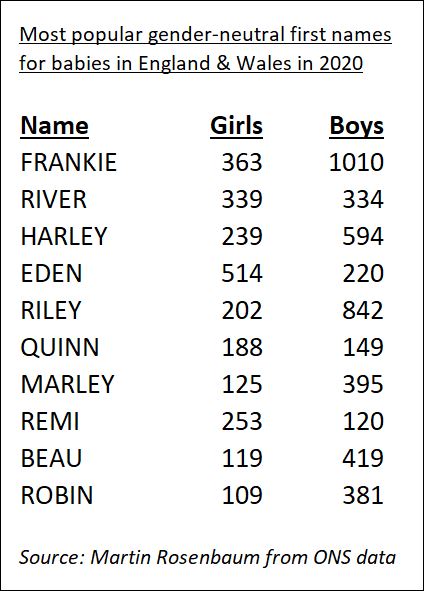
They are ordered according to how often they were used for whichever sex they were less popular for. This measure is mine. As it reflects the frequency of the names in both cases, it seems to me to capture gender-neutrality or ‘unisexness’ better than any other criterion I came up with, although other approaches are possible.
Here is a comparable table compiled on the same basis for the past 25 years in total (the published ONS data goes back to 1996), featuring the 12 first names given at birth both to over 2,000 girls and over 2,000 boys:
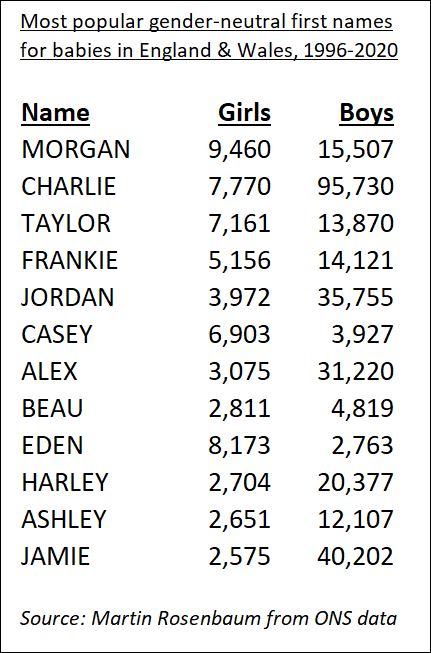
So Morgan is the leading unisex first name over this time range, the only name to have been given to over 9,000 girls and also over 9,000 boys in the 25-year period from 1996 to 2020. However it has declined considerably in popularity in recent years, as have some other names in this table.
It’s often said that there has been a long-term phenomenon of unisex names becoming ‘feminised’. Some traditional boys’ names start to become popular for girls too, and then parents apparently no longer want to give them to boys (classic examples include Evelyn and Shirley).
However there seems to be little evidence of such a trend in the ONS data over the past 25 years.
As one way to get an overall impression of this, each line on this chart below represents one of the 50 most popular gender-neutral names, and each column is a year, going chronologically from 1996 on the left to 2020 on the right. For each name, cells are coloured more in red for years when they were more popular for girls and more in blue when more popular for boys. (The colour-coding may be stereotypical, but it does make the chart more intuitive to grasp easily).
As time advances, the names move more from the redder/pinker areas to bluer ones than in the opposite way (although by no means uniformly).
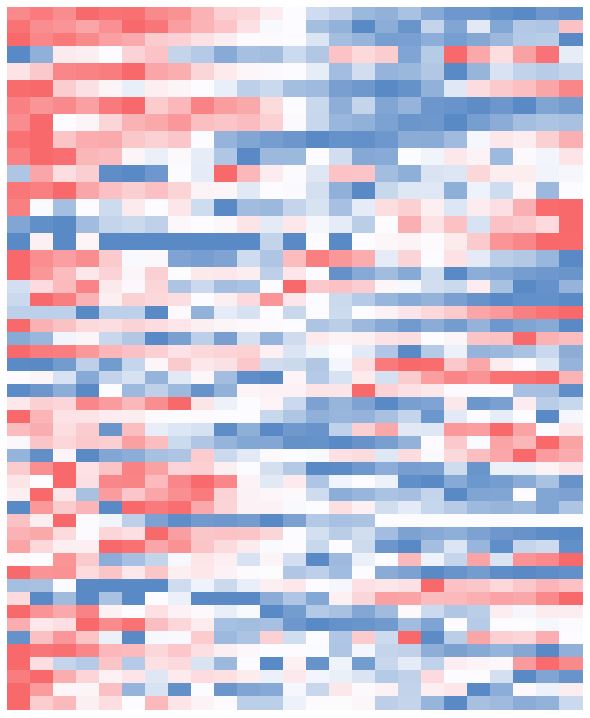
That suggests these gender neutral names are not becoming feminised; if anything they appeared to get a bit more popular for boys (ie bluer) and less popular for girls.
However looking at the data in more detail it seems that what is happening is mainly a trend amongst girls: in particular it’s becoming less common to give girls names like Charlie and Jamie, which are largely boys’ names but which 15 to 25 years ago were also used for a fair number of girls.
What this does mean is that unisex names now are more likely to be broadly similar in popularity for both girls and boys, rather than include various predominantly boys’ names which are also given to some girls.
Finally, it’s important to note that generally these unisex or gender-neutral names aren’t very popular at all. So from my list of top 10 unisex names in 2020, Frankie, the highest for boys, is only 61st in popularity for boys’ names overall that year; and Eden, the highest for girls, only just squeezes into the top 100 girls’ names at 98th.
Parents do seem to prefer to give their children names which are clearly recognisable as belonging to either a girl or a boy.
Note: The ONS data (and therefore this analysis) is based on the specific spellings of names on birth certificates and does not take account of similar names. In other words, Charlie and Charley, for example, are treated as entirely different names.
From Morgan to Frankie Read More »